
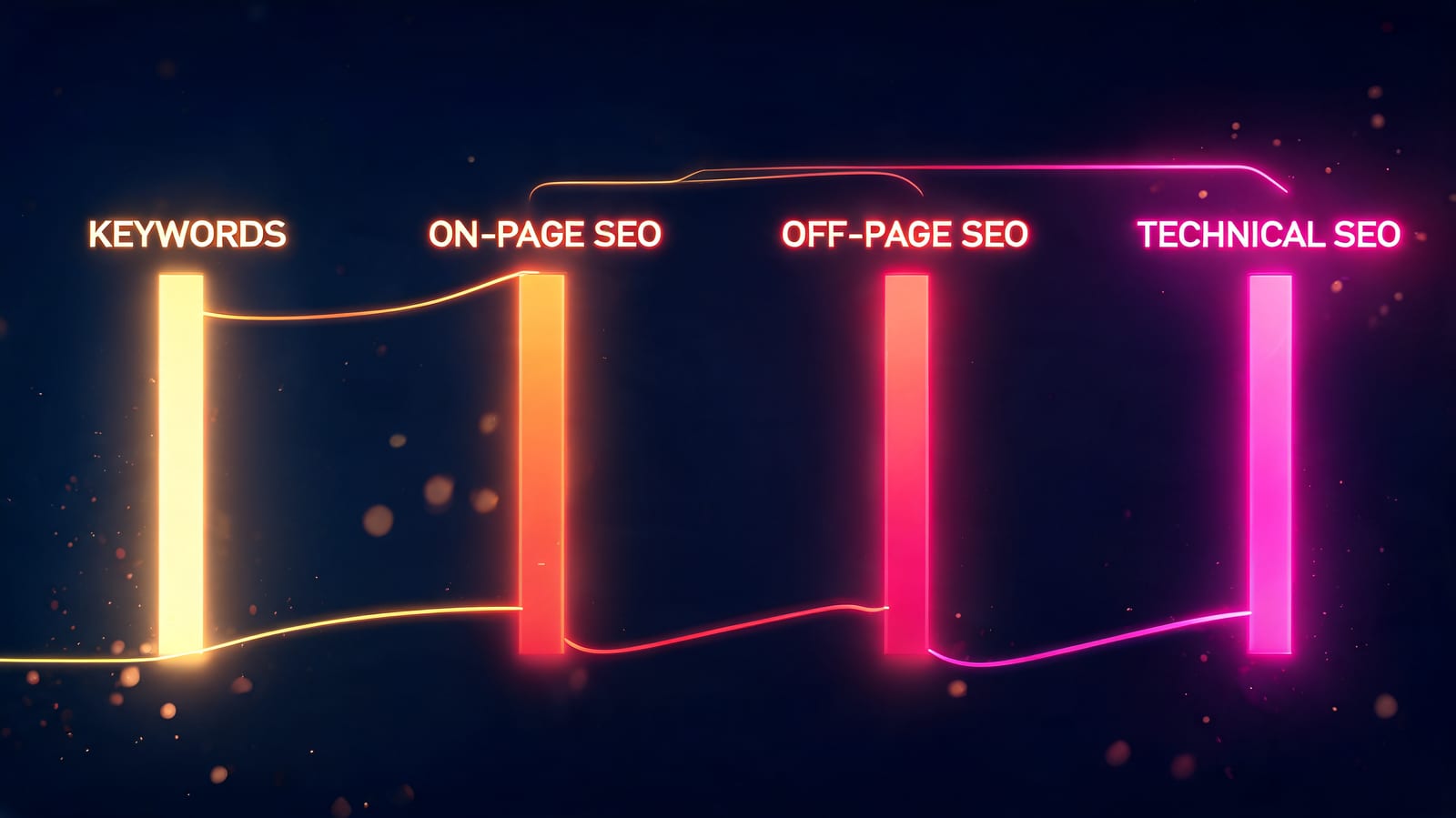
The four pillars of SEO are technical SEO, content, on-page SEO, and off-page SEO. Technical SEO makes your site crawlable and fast, content gives Google something worth ranking, on-page SEO signals what each page is about, and off-page SEO (mostly backlinks) shows that other sites trust you. Get all four right and rankings follow; neglect one and the others can't fully carry you.
Why think in pillars at all?
Pillars turn hundreds of ranking factors into four questions you can actually check. Each pillar answers a different question Google asks about your page: Can I access it? Is it useful? Is it clearly about this topic? Do others vouch for it? Miss any one and you leave rankings on the table.
Google's own guide to how Search works describes three stages, "and not all pages make it through each stage": crawling, indexing and serving search results. The technical pillar gets you through the first two; the other three decide how well you do in the third. Google also states plainly that it "doesn't accept payment to crawl a site more frequently, or rank it higher," so all four pillars have to be earned.
Pillar 1: Technical SEO (can Google reach and read your site?)
Technical SEO is the plumbing: if Google can't crawl, render, and index your pages, nothing else matters. The core checklist:
- Crawlability: a clean sitemap, no accidental
noindextags, a sensiblerobots.txt. - Speed and Core Web Vitals: pages that load fast and don't jump around as they render. Google's Web Vitals guidance sets the "good" thresholds: Largest Contentful Paint within 2.5 seconds, Interaction to Next Paint of 200 milliseconds or less, and Cumulative Layout Shift of 0.1 or less.
- Mobile-friendliness: Google indexes the mobile version of your site first.
- HTTPS and site structure: secure, logically organized URLs.
You don't need perfection here. You need no blockers. A brilliant article on a page Google can't crawl earns zero traffic.
Pillar 2: Content (do you deserve to rank?)
Content is what actually answers the searcher's question, so it decides whether a page deserves to rank at all. This pillar is about creating pages that match real search intent and go deep enough to be useful. Strong content:
- Targets a specific query and answers it directly (ideally in the first sentence, the way this page opens).
- Covers the topic thoroughly instead of skimming it.
- Reflects real expertise, examples, and a point of view, not reworded filler.
Google's helpful content guidance describes "people-first content" as content "created primarily for people, and not to manipulate search engine rankings." Thin, mass-produced content works against you, so depth beats volume.
Pillar 3: On-page SEO (is it clear what each page is about?)
On-page SEO is how you tell search engines and users what a page is about. It overlaps with content but focuses on the signals around the words:
- Title tags and meta descriptions that include your target keyword and earn the click.
- Header structure (
H1,H2s) that maps the page's logic, often phrased as related questions. - Internal links that connect related pages, like linking a mention of link value to what is domain authority.
- Anchor text that describes what you're linking to.
- Image alt text and clean URLs.
On-page work is the highest-leverage pillar for most sites because you fully control it and can fix it today.
Pillar 4: Off-page SEO (do other sites trust you?)
Off-page SEO is everything that happens away from your own site to build its reputation, and it's dominated by backlinks. When other websites link to you, Google treats the link as a signal about your page. This pillar is why two pages with equally good content can rank far apart: the one with more trusted, relevant links usually wins.
Off-page SEO includes:
- Backlinks from relevant, authoritative sites. See are backlinks good for SEO.
- Brand mentions and digital PR.
- Reputation signals like reviews and citations.
Because good links are hard to fake, this is the hardest pillar to build from scratch. One way to start is trading relevant in-content links with other site owners, which is how Backlinkster works; each swap is verified by API.
Which pillar should you start with?
Start with technical fixes, then content and on-page together, then off-page as an ongoing effort. For a typical site:
- Technical first: fix anything blocking crawling or killing speed. This is mostly a one-time cleanup.
- On-page and content together: publish useful pages that are clearly structured.
- Off-page last (and ongoing): once you have pages worth linking to, build the backlinks that push them up.
The order matters because backlinks pointing at a slow, thin page waste their value. Expect patience too: Google's SEO starter guide says "some changes might take effect in a few hours, others could take several months." New pages are slower still: in Ahrefs' study of how long pages take to rank, only 1.74% of newly published pages reached the top 10 within a year.
Frequently asked questions
What are the 4 pillars of SEO?
Technical SEO (crawlability, speed, indexing), content (pages that answer the search), on-page SEO (titles, headings, internal links) and off-page SEO (mostly backlinks and reputation).
Which pillar of SEO is most important?
None works alone. Technical problems can block everything else, so fix those first. After that, content and backlinks usually decide rankings in competitive searches.
Is technical SEO or content more important?
Technical SEO is a threshold: once Google can crawl and index the page, more technical work brings smaller gains. Content keeps paying off, because it decides whether the page deserves to rank.
What are good Core Web Vitals scores?
Google's Web Vitals guidance counts LCP within 2.5 seconds, INP of 200 milliseconds or less and CLS of 0.1 or less as good.
How long do SEO changes take to work?
Google's SEO starter guide says some changes take effect in a few hours and others take several months. Backlinks and new content usually sit at the slower end.
The bottom line
Technical, content, on-page, and off-page SEO aren't a menu to pick from; they're four legs of the same table. Most sites are strong on one or two and weak on the rest, and the weak pillar is usually what caps their rankings. Audit yourself honestly against all four and fix the weakest one first. For sites with solid content, that is very often the off-page backlink pillar.
Related: The three main areas of SEO · What is off-page SEO? · The 4 intents of SEO