
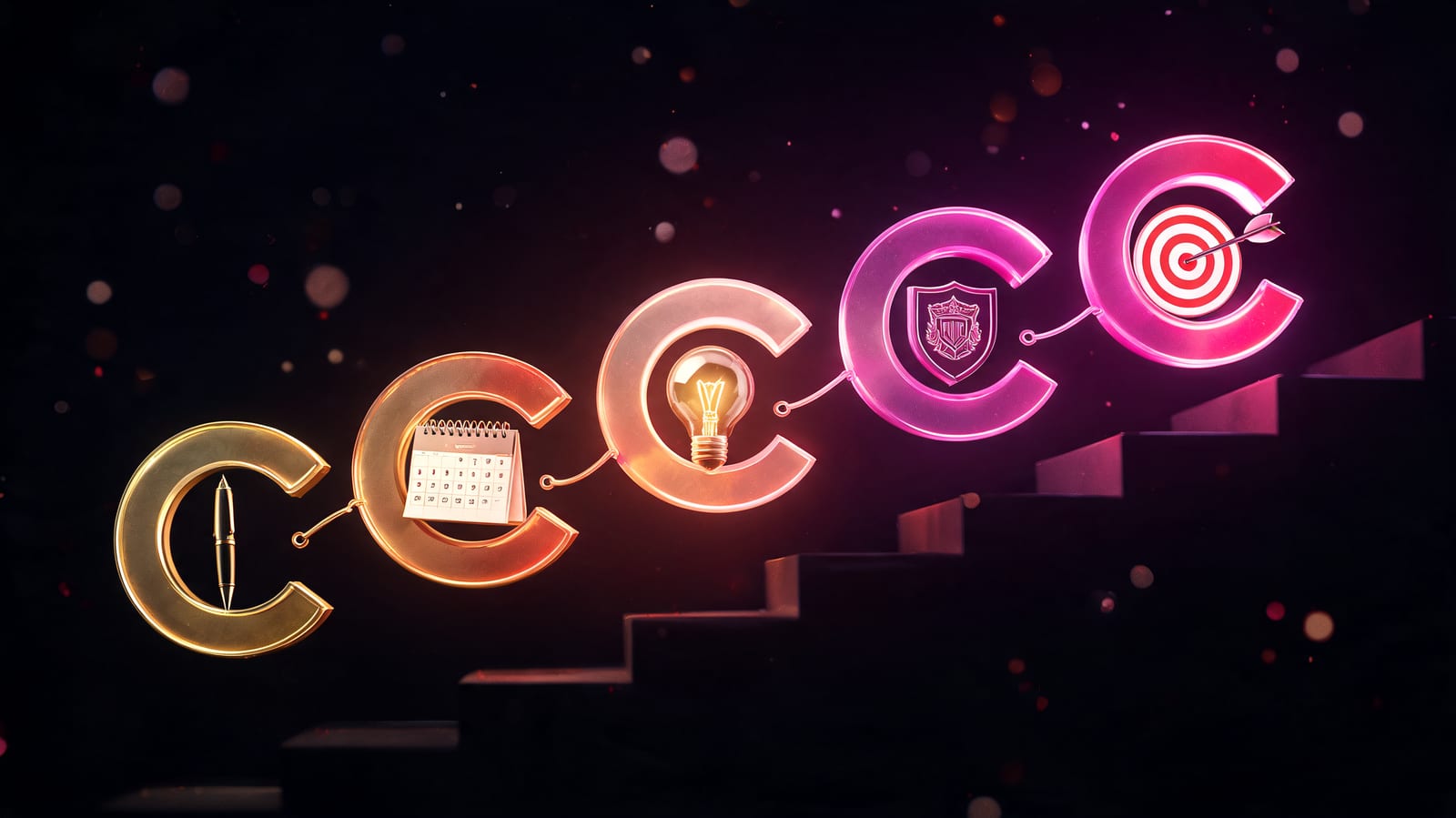
The 5 C's of content marketing are Clarity, Consistency, Creativity, Credibility, and Conversion — a checklist for whether a piece of content is actually built to do its job. Clarity means it's understood, Consistency means it keeps showing up, Creativity means it's worth noticing, Credibility means it's believed, and Conversion means it moves the reader toward an action. Miss any one and the content usually underperforms in a predictable way. Here's what each C means and how to apply it.
1. Clarity — can a stranger understand it instantly?
Clarity is the first C because it's the one most content fails on. If a reader can't tell within a few seconds what your piece is about, who it's for, and what they'll get from it, they leave — and no amount of the other four C's saves you.
Clarity means a specific promise in the headline, one main idea per page, plain language over jargon, and structure a skimmer can follow (short paragraphs, real subheadings, one point each). A good test: could someone who skims only your headings and first sentences still get the gist? If not, you've buried it. This is also why targeting one clear question per page works so well for search — it forces clarity. The 4 stages of SEO starts with exactly this kind of intent-matching.
2. Consistency — do you show up reliably?
Consistency is the C that separates content marketing from content making. One brilliant article is a lottery ticket. A steady stream of useful pages is a compounding asset — it builds topical depth, gives Google reasons to trust your site, and trains an audience to expect you.
Consistency has two dimensions:
- Cadence — publishing on a rhythm you can actually sustain. Two solid pieces a month beats eight rushed ones followed by three months of silence.
- Voice and standard — every piece sounds like it came from the same brand and clears the same quality bar. Inconsistent quality quietly erodes trust; readers learn they can't rely on you.
The trap is choosing a cadence you can't hold. Pick the pace you'll still be keeping in six months, not the one that looks impressive this week.
3. Creativity — is it worth noticing?
The web is saturated. Creativity is what earns attention in a feed full of near-identical content. It doesn't mean gimmicks — it means a genuinely useful angle, a fresh framing, a data point nobody else has, a format that fits the idea, or simply saying the true thing everyone else is too cautious to say.
Creativity is also your defense against the biggest risk in content today: sounding like everything else. Google explicitly rewards content that adds something beyond a rehash — original insight, first-hand experience, a distinct point of view. If your article is the average of the top ten results, you've built something that deserves to rank eleventh. Ask of every piece: what does this offer that the reader can't already get from the first result?
4. Credibility — does the reader believe it?
Credibility is trust made concrete. Readers (and Google) decide fast whether to believe you, and they use signals: specific evidence over vague claims, named sources, real examples, author expertise, and honesty about trade-offs and limits. Content that only sells and never admits a downside reads as marketing and gets discounted.
Two credibility levers matter most:
- Demonstrated experience — showing you've actually done the thing, not just read about it. Specifics and concrete numbers signal this; generic advice signals the opposite.
- Backlinks from reputable sites — off-page credibility. When other trusted sites link to your content, they vouch for it, and that endorsement carries real weight with Google. Earning those links is often the missing half of a content program that produces good work nobody trusts yet. A 1-for-1 link exchange between real, relevant site owners — the model behind Backlinkster — is one white-hat way to build that off-page credibility deliberately instead of just hoping links arrive.
5. Conversion — does it move the reader forward?
Content that informs but never asks for anything is a hobby, not marketing. Conversion is the fifth C: every piece should give the reader a clear, appropriate next step — subscribe, try the product, read the related guide, book a call. The step should match the reader's stage. Someone reading an introductory explainer isn't ready to buy; the right conversion there is to keep them learning (an email signup or a deeper article), not to hard-sell.
The most common mistake is content with no next step at all — the reader finishes, nods, and leaves with nowhere to go. Even a single well-placed internal link or call to action turns a dead-end page into a doorway.
How the 5 C's work together
They're a chain, not a menu. Clarity gets you understood, Creativity gets you noticed, Credibility gets you believed, Conversion gets the payoff — and Consistency multiplies all of it over time. A piece can be clear, creative, and credible and still fail if it never asks for the conversion; it can convert beautifully but never get read if it isn't consistent enough to build an audience.
Run any piece of content through all five before you publish: Is it clear? Am I consistent? Is it creative enough to notice? Is it credible? Does it convert? The gaps that checklist exposes are usually the exact reason a piece isn't performing.
Related: What are 5 content pillars? · The 4 stages of SEO · What is a link exchange?