
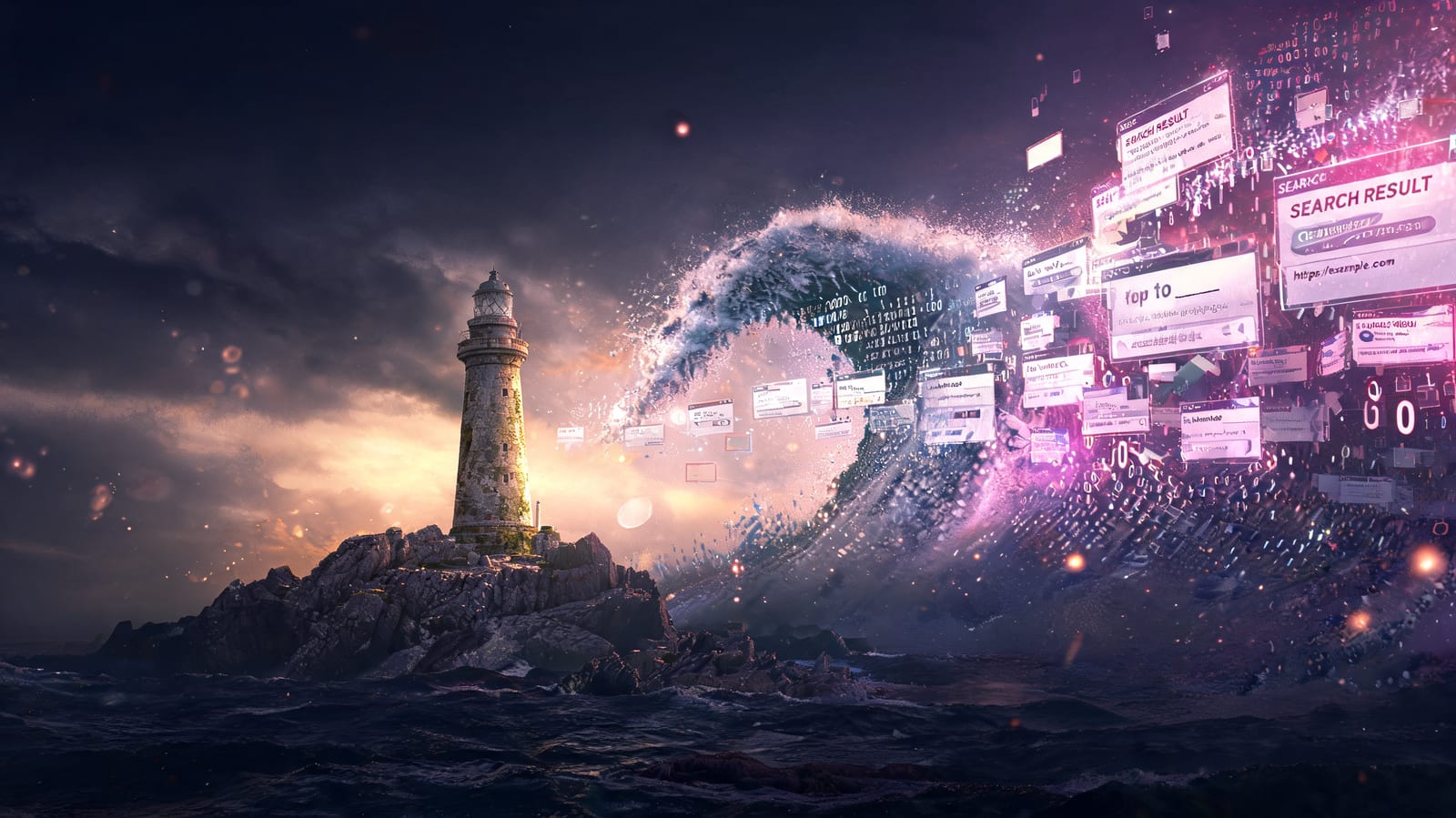
The biggest threat to SEO in 2026 is the decoupling of rankings from traffic — the fact that you can hold position 1 and still lose visitors, because the answer now appears above your link instead of behind it. Everything else people panic about (AI content, algorithm updates, competitors) is downstream of that one shift. Ranking was never the goal; the click was. And the click is what's under pressure.
Here's the honest ranking of what actually threatens your search traffic this year.
1. The collapse of the click
This is the real one. AI Overviews, featured snippets, and answer panels resolve a growing share of queries on the results page itself. The user gets what they came for and never leaves Google. Your ranking report looks identical; your analytics doesn't.
The queries hit hardest are the ones with a short, factual answer — definitions, conversions, opening hours, "what is X." The queries barely touched are the ones where the answer isn't the point: comparisons where people want to weigh options, decisions with money attached, anything requiring trust in a source. That split is the whole strategic story of 2026. If your content lives entirely in the first category, your traffic is structurally exposed no matter how well you rank.
What to do: audit your top pages by query type, not by position. Move investment toward pages that survive being summarized — ones where someone still needs you after reading the summary.
2. Commodity content becoming worthless
Publishing became free. When anyone can generate a competent 1,200-word article on any topic in seconds, competent 1,200-word articles stop being worth anything — the supply is infinite and the differentiation is zero. Google's response has been consistent: reward content that demonstrates something the model couldn't have produced from training data alone.
That means original data, real testing, actual customer experience, a genuine point of view, a number you measured yourself. The threat here isn't AI writing content. It's that the floor rose and everything at the floor is now invisible. See is SEO dead or evolving in 2026? for the longer version of this argument.
3. Authority concentration
Google has spent years leaning harder on trust signals, and the practical effect is that established, well-linked domains absorb a disproportionate share of the visibility — especially on anything touching money, health, or safety. A new site with better content routinely loses to an older site with worse content and a decade of links.
This is where the threat and the remedy are the same thing: authority is earned largely through other sites vouching for you. It compounds, which is bad news if you're starting and good news the moment you start. A small site that adds relevant links steadily for a year is a meaningfully different site at the end of it — see how to improve domain rating in 6 months.
4. Platform dependence
Every business that treats Google as its only acquisition channel has handed a single company a veto over its revenue. That was always true. What changed is that the veto now gets exercised more often, via interface changes nobody voted for and nobody can appeal.
This isn't an argument against SEO — organic search is still one of the highest-intent channels that exists. It's an argument against SEO being the only thing. Email lists, communities, referral, direct — the channels you own are the hedge.
5. Algorithm updates (the overrated threat)
Updates get the headlines and deserve the least anxiety. Sites that get wrecked by a core update almost always share a profile: thin or scaled content, a manufactured link profile, no real audience. Updates aren't a lottery that occasionally punishes good sites — they're Google getting incrementally better at recognizing what it already said it didn't want.
If you're worried about the next update, the useful question isn't "how do I protect myself." It's "am I doing anything that only works until it's detected?" If the answer is no, updates are mostly noise.
What isn't the threat
AI isn't replacing SEO. It's changing the interface, and interfaces have changed before. People still have questions, and something still has to answer them from sources. Being one of those sources is the same job under a new name — we went through the AEO/GEO acronyms here.
Backlinks aren't dead. If anything, the shift raises their value: when a machine has to decide which sources are trustworthy enough to cite, it leans on the same corroboration signals — who references this site, and are they credible? Do backlinks still matter in 2026? covers the evidence.
The strategy that survives all five
Notice that the defenses overlap. Content that can't be summarized away, authority that makes you citable, and channels you own — that's one strategy, not five.
The authority piece is the one most people skip because it's the slowest. It doesn't have to be. Backlinkster exists for exactly this: real site owners trading in-content links 1-for-1, verified live by API, so the compounding starts now instead of after you've built an audience. Five free swaps a month is enough to find out whether it moves your numbers.
The bottom line
The biggest threat to SEO in 2026 is that rankings stopped guaranteeing traffic — the click is being intercepted before it reaches you. The response isn't to rank harder. It's to be the kind of source that people and machines still need to reach: original where the answer isn't obvious, trusted where trust is scarce, and not solely dependent on one company's interface decisions.
Related: Is SEO dead or evolving in 2026? · What is replacing SEO? · Do backlinks still matter in 2026?