
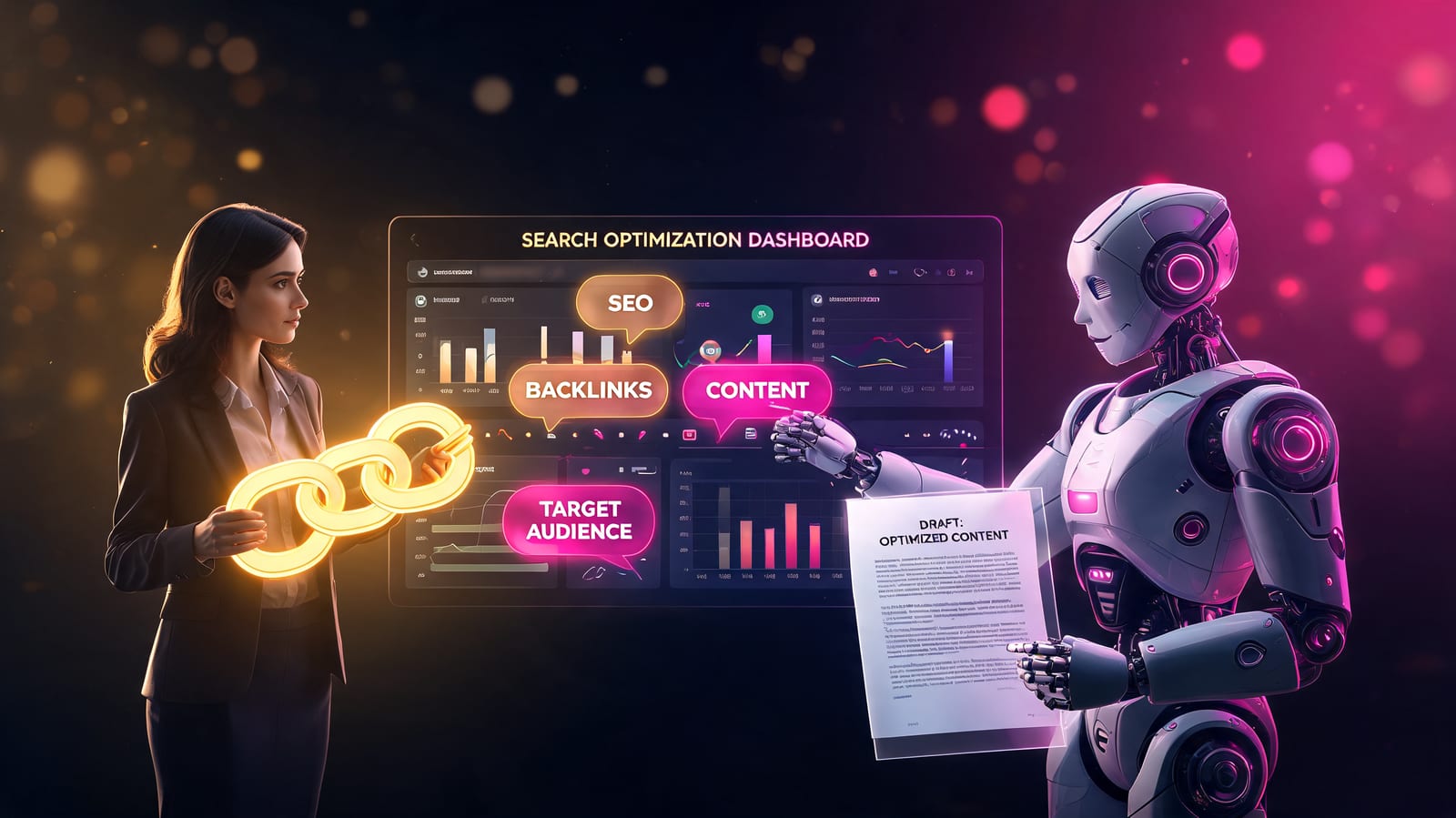
Yes — ChatGPT can do a large share of the tasks inside SEO: brainstorming keywords, clustering topics, drafting briefs and outlines, writing and editing copy, generating meta tags and schema, and explaining technical issues. What it can't do is SEO itself — it can't publish, can't earn backlinks, can't verify facts, and can't make a page rank on its own. The right way to think about it: ChatGPT is a fast, tireless assistant for the parts of SEO that are language and analysis, and useless for the parts that are execution, trust, and real-world signals.
Here's the honest split.
What ChatGPT is genuinely great at
Ideation and keyword expansion. Give it a seed topic and it will spin out related questions, subtopics, and angles in seconds. It's excellent for the messy first pass — "what are 40 questions someone new to link building might ask?" It won't give you real search volumes (it's guessing), but for coverage and topic clustering it's a huge accelerator.
Content briefs and outlines. ChatGPT turns a target keyword into a structured outline — headings, questions to answer, angles to cover — faster than any human. Used to brief a writer or to organize your own thinking, it's a real time-saver.
Drafting and editing. It writes competent first drafts and is even better as an editor: tightening flabby sentences, fixing structure, adjusting tone, generating variations of a headline or meta description. The draft always needs a human pass, but starting from a draft beats starting from a blank page.
Technical explanation and code. Ask it what a robots.txt directive does, why a canonical tag matters, or to generate FAQPage structured data, and it's fast and usually right on well-established topics. It's a superb tutor for SEO fundamentals.
Repetitive language work at scale. Meta titles and descriptions for 50 pages, alt text drafts, reformatting — the boring, high-volume language tasks are exactly where it shines.
What ChatGPT can't do (and where people get burned)
It can't verify facts. ChatGPT generates plausible text, and plausible is not the same as true. It will confidently invent statistics, cite studies that don't exist, and state outdated tactics as current. Publishing its output unchecked is how sites end up with confident, wrong, and occasionally embarrassing content. Everything factual needs a human to verify.
It can't judge accuracy on your specific niche. For anything current, specialized, or contested, its training data is months stale and averaged across the whole web. It doesn't know the 2026 state of your industry — it knows the internet's consensus from its last training cut.
It can't produce originality on its own. Here's the deepest limitation. Google increasingly rewards content that adds something — first-hand experience, original data, a genuine position — and penalizes content that's just a smoother average of what already ranks. Pure ChatGPT output is, by design, the average. Left unedited, it produces exactly the scaled, generic content Google is trying to filter out. The value has to come from you — your data, your examples, your point of view. ChatGPT can express it; it can't originate it.
It can't publish, build, or earn anything. This is the big one. SEO isn't just writing — it's shipping pages to a live site, fixing technical issues, and earning the off-page trust that makes pages rank. ChatGPT can draft the content but it can't push it live, can't get another site to link to you, and can't make Google trust your domain.
The line that matters: on-page help vs. off-page trust
SEO has two halves. On-page — the content, structure, and technical setup — is where ChatGPT genuinely helps, because it's mostly language and analysis. Off-page — the backlinks and reputation that tell search engines your site is trustworthy — is where it can do nothing at all.
And off-page is usually the actual bottleneck. Two sites can publish equally good, ChatGPT-assisted content; the one that ranks is almost always the one with more quality backlinks pointing at it. Links are a real-world trust signal — other site owners choosing to reference you — and no language model can manufacture that. (Anyone selling "ChatGPT backlinks" is selling nothing: links printed in a chat window aren't real backlinks and pass zero value.)
So the honest answer to "can ChatGPT do SEO" is: it can do the writing-and-analysis half faster than you can, and none of the trust-building half.
How to actually use ChatGPT for SEO
Treat it as a force-multiplier on the tasks it's good at, with a human owning judgment and everything off-page:
- Research and cluster — use it to expand topics and organize question clusters, then validate demand with a real keyword tool.
- Brief and outline — let it structure the page; you decide the angle and what original value you'll add.
- Draft, then heavily edit — start from its draft, inject your data and experience, verify every fact, cut the generic filler.
- Automate the boring language work — meta tags, schema, reformatting at scale.
- Own the off-page yourself — publishing, relationships, and links are on you.
That last step is where most SEO is won or lost, and it's the part no AI touches. Earning links used to mean slow outreach; Backlinkster makes it deliberate instead — real site owners in your niche trading in-content links 1-for-1, verified live. Use ChatGPT to produce the pages faster, and a link exchange to earn the trust that actually ranks them. Free tier is five swaps a month.
The takeaway
ChatGPT can do most of the tasks in SEO and none of the trust in SEO. Use it to move faster on keywords, briefs, drafts, and technical explanations — but verify everything, add original value it can't invent, and remember that the part that actually makes pages rank, the off-page trust, is still entirely human work.
Related: How to do SEO for ChatGPT · How to get backlinks from ChatGPT · What is replacing SEO? · What AI Is Better Than ChatGPT?