
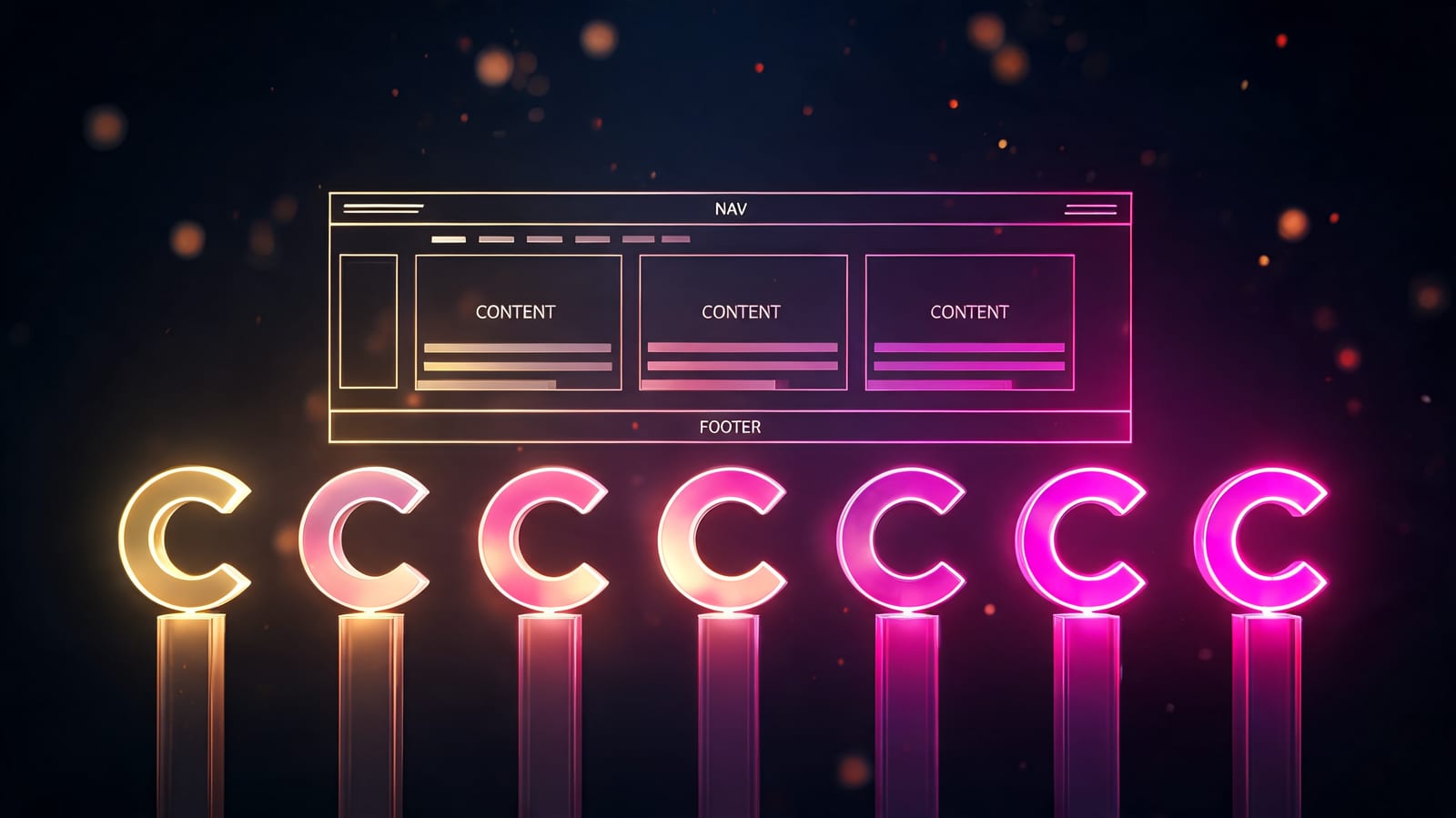
The 7 C's of a website are Content, Context, Clarity, Credibility, Conversion, Consistency, and Connection. Together they form a checklist for a site that works rather than one that merely exists: say something useful, fit the visitor's intent, be easy to follow, earn trust, ask for one action, hold together, and keep the relationship going.
The list has variants (some swap in "Commerce" or "Customization"), but these seven cover what a site actually lives or dies on. Content is what you say; Context is whether it fits why the visitor came; Clarity is whether they can understand it; Credibility is whether they trust you enough to act; Conversion is whether the page asks for a clear next step; Consistency is whether it holds together across pages; and Connection is whether you build a relationship past visit one. Here's each one, why it matters, and one thing to fix.
1. Content: the thing people actually came for
What it is: the words, pages, and answers on your site. Everything else is a container for this.
Why it matters: nobody visits a website for its navigation. They come for an answer, a product, or a decision, and content delivers it. It's also the raw material SEO optimizes. Thin, generic content is the most common reason a page gets built and then does nothing: it doesn't rank, doesn't convert, and doesn't get linked to. Google's own guide to creating helpful, people-first content asks whether a page provides "original information, reporting, research, or analysis," which is the same test in different words.
Fix this: take your most important page and ask, "Could a visitor get this exact information from ten other sites?" If yes, it's replaceable, and therefore ignorable. Add something only you have: a real number, a firsthand opinion, a specific example. The 5 C's of content marketing go deeper on making content that earns its place.
2. Context: relevance and intent
What it is: whether the page matches why the visitor is there. Same words, wrong context, wasted visit.
Why it matters: someone searching "how to fix X" wants a guide; someone searching "best X tool" wants a comparison; someone clicking your ad wants the exact thing it promised. Serve the wrong format and they bounce. Search engines read context too. Matching intent is one of the oldest and most durable ideas in ranking, which is why it tops every serious list of main SEO practices.
Fix this: for each key page, name the one query or moment it's built for, then check the format answers that. If a "pricing" search lands on a wall of feature copy with the price buried, context is broken even if the content is great.
3. Clarity: can they understand and move
What it is: how easily a visitor reads, understands, and navigates. Layout, hierarchy, plain language, obvious menus.
Why it matters: confusion is silent. People don't email you to say your nav is baffling; they just leave, and they leave fast. Nielsen Norman Group's summary of a Microsoft Research study covering 205,873 pages found that users often leave web pages in 10 to 20 seconds, and that the first 10 seconds decide whether they stay. Clarity turns good content into usable content: clear headings, short paragraphs, one idea per section, a menu that answers "where am I and where do I go next."
Fix this: open your homepage and give a stranger five seconds. Can they say what you do, who it's for, and what to click next? If not, cut the clever tagline and lead with a plain sentence. Clarity almost always means removing things, not adding them.
4. Credibility: do they trust you enough to act
What it is: every signal that says "this site is legitimate and worth believing." Design quality, reviews, real contact info, named authors, and (the big one off your own site) who else vouches for you.
Why it matters: a visitor decides whether to trust you quickly, and no amount of great content converts someone who doesn't believe you. Google weighs this as well: of the qualities in its E-E-A-T framework, its helpful-content guidance says "trust is most important." Credibility splits in two. On-site signals (testimonials, case studies, security badges, a real About page) you control directly. Off-site authority you don't, and it's the harder, more convincing half: when other credible sites link to you, people and search engines read it as an endorsement you couldn't write yourself. Backlinks are the vote you can't cast for yourself.
Fix this: add the on-site signals today: real testimonials with names, a findable contact page, and nothing that looks like an unedited template. Then work the off-site half deliberately, because it moves rankings and it's the slowest to build. This is the wall Backlinkster is built for: it pairs you with site owners in related niches to trade one-for-one in-content links, and every swap is verified by API as live and dofollow, so "nobody vouches for me yet" turns into earned authority. Keep exchanges relevant and moderate, since Google's spam policies name "excessive link exchanges" as link spam. Off-page trust is also stage four of the 4 stages of SEO, the stage most sites skip before they stall on page two wondering why.
5. Conversion: one clear next step
What it is: whether the page moves the visitor toward a specific action: buy, sign up, book, subscribe.
Why it matters: traffic that does nothing is a vanity metric. A page can be read, understood, and trusted and still fail if it never asks for anything, or asks for five things at once.
Fix this: give each important page one primary action and make it visually obvious. If your homepage has a "Buy," a "Learn more," a newsletter box, and social icons all competing, you don't have a call to action. You have noise.
6. Consistency: it holds together
What it is: a coherent look, voice, and quality across every page and every visit, whether that's the homepage or a buried blog post.
Why it matters: inconsistency quietly erodes credibility. A polished landing page next to a broken, off-brand support page tells the visitor the whole thing is held together with tape. It works in reverse too: a brand that shows up the same everywhere starts to feel trustworthy.
Fix this: click through ten random pages as if you'd never seen the site. Flag anything that feels like a different company made it: a stale footer, an off button style, a tone that swings from formal to jokey. Fix the outliers; consistency is about raising the floor, not the ceiling.
7. Connection: the relationship past visit one
What it is: how you keep a relationship going after someone leaves: email capture, community, useful follow-up. Some frameworks call this C "Community."
Why it matters: most first-time visitors won't convert, and with no way to reach them again you paid to acquire them once and lost them for good. Connection turns one-time traffic into an audience you own: people who come back, refer others, and eventually buy. It's the one channel no algorithm can take away.
Fix this: give visitors a low-friction reason to stay reachable: a genuinely useful email list, a free resource, a community worth joining. Not a "subscribe for updates" box nobody wants, but an actual reason to come back.
Putting the 7 C's to work
Don't perfect all seven at once. Run them as a diagnostic: score your most important page one to five on each C, and fix the lowest number first. Almost every underperforming site has one or two C's dragging the rest down, usually Clarity, Conversion, or Credibility. But they work as a system: great content in the wrong context fails, and a trustworthy page nobody can find fails. Get all seven pulling the same direction and each makes the others pay off.
Frequently asked questions
What are the 7 C's of a website?
The 7 C's of a website are Content, Context, Clarity, Credibility, Conversion, Consistency, and Connection. They cover what the site says, whether it fits the visitor's intent, how easy it is to follow, whether it earns trust, whether it asks for one clear action, whether it holds together, and whether it keeps visitors coming back.
Are the 7 C's of a website the same as the 7 C's of marketing?
No. The 7 C's of a website judge a single site and its pages. The 7 C's of marketing are a broader framework for a whole marketing strategy, and the lists differ depending on who wrote them. Some website versions also swap in "Commerce," "Customization," or "Community," so treat the list as a checklist rather than a fixed standard.
Which of the 7 C's matters most?
The one your site is weakest on. Score your most important page from one to five on each C and fix the lowest score first. In practice Clarity, Conversion, and Credibility are the most common weak spots, because visitors leave quickly when a page is confusing, asks for nothing, or gives them no reason to trust it.
How do backlinks relate to the 7 C's?
Backlinks are the off-site half of Credibility. When relevant, trusted sites link to you, visitors and search engines read it as an endorsement you couldn't write yourself. On-site trust signals help, but links from other sites are harder to fake and take longer to build, so they are worth working on steadily.
Related: The 5 C's of content marketing · Main SEO practices · The 4 stages of SEO · What Are the 7 C's in Marketing?