
How Do I Get a Google Knowledge Panel?
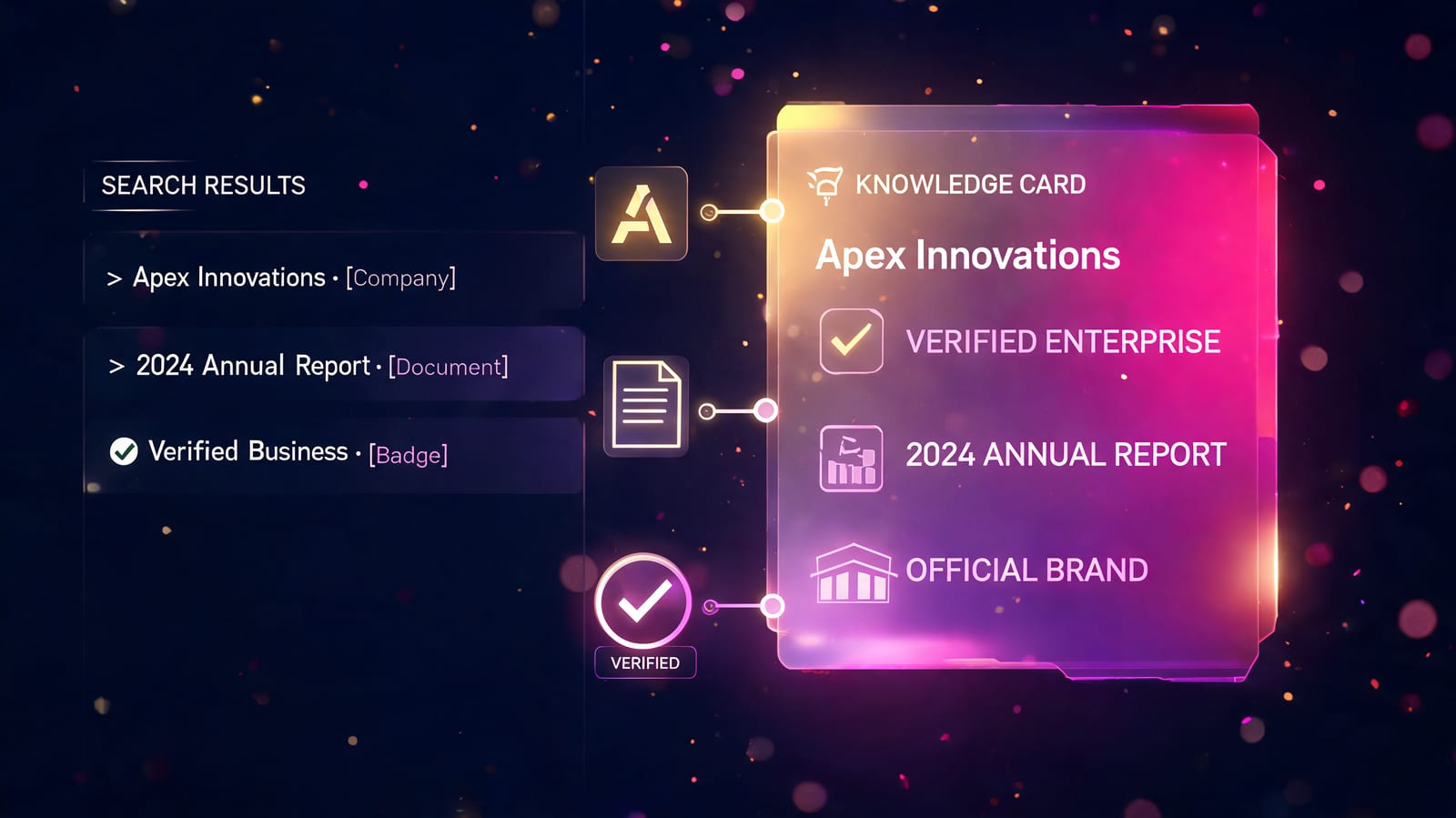
You can't apply for a knowledge panel. Google generates one automatically once it recognises your brand as a distinct entity and finds consistent, corroborating information about it across independent sources. The work is entity-building: an unambiguous name, correct structured data, and enough third-party coverage that Google can verify who you are.
There's no form, no queue and no paid route. Every service selling "knowledge panel creation" is selling you some combination of the work below, usually with a Wikipedia attempt bolted on that gets deleted. What follows is the actual mechanism and the order to do it in.
What a knowledge panel actually is
The box that appears to the right of search results (or above them on mobile) is a rendering of an entry in Google's Knowledge Graph — a database of entities (people, companies, products, places) and the relationships between them.
Three things follow from that, and they explain most of the confusion:
- The panel is an output, not an input. You don't create the panel; you create the conditions under which Google is confident enough about an entity to show one.
- Google needs corroboration, not assertion. Your own website claiming you're a company founded in 2019 is one source. Three independent sources agreeing is a fact. The Knowledge Graph is built on agreement across sources.
- Entity recognition ≠ ranking. A site can rank well for its own name and still have no panel, because ranking and entity confidence are different systems.
Google pulls Knowledge Graph data from licensed datasets, structured data on your own site, open sources like Wikipedia and Wikidata, and general crawling of the web. No single one of those is required.
The prerequisites most brands fail
Before any of the tactics matter, two things have to be true.
Your name has to be unambiguous. If your company shares a name with a film, a footballer, a chemical compound or four other companies, Google has an entity disambiguation problem and will usually resolve it in favour of whichever entity it's most confident about. That isn't you. Brands with distinctive, coined names get panels far more readily than brands named after a common noun — which is a real argument for distinctive naming that nobody makes at the branding stage.
You have to exist off your own website. A brand that appears only on its own domain and its own social profiles has exactly one source, repeated. Google cannot corroborate a single source with itself.
The build order
1. Make your own site machine-readable
Add Organization (or Person, for individuals) schema markup on your homepage, with a sameAs array pointing at every official profile you control — LinkedIn, X, GitHub, Crunchbase, YouTube, Facebook. This is how you tell Google that all those accounts are the same entity as the site.
Include name, legalName, url, logo, foundingDate, description, and address if you have a physical one. What is schema markup covers implementation. Google is explicit that structured data doesn't guarantee any rich result, panels included — but without it you're asking Google to infer from prose what you could have simply stated.
2. Write a real About page
Not a mission statement. Founders with full names, founding year, location, what the company does in plain language, and — if they exist — press mentions, funding, headcount. This page is the source Google checks your structured data against, and it's the one AI systems read when asked who you are.
3. Get consistent across every profile you own
Same legal name, same logo, same founding date, same one-line description everywhere. Inconsistency is the single most common reason Google stays unconfident about a mid-sized brand. If your LinkedIn says 2018 and your About page says 2019, you've manufactured a contradiction in a dataset built on agreement. For local businesses this extends to name, address and phone number — see what are local citations in SEO.
4. Earn independent coverage
This is the part that can't be shortcut and the part that does most of the work. Google needs sources it didn't get from you: industry publications, podcast appearances, conference speaker listings, review platforms, roundups, interviews, news coverage.
Unlinked mentions count here — entity corroboration doesn't require a hyperlink, though links help Google associate the mention with your domain. Do brand mentions help SEO goes into what those mentions are worth beyond panels.
5. Consider Wikidata, and be realistic about Wikipedia
Wikidata is an open structured database that Google reads. Anyone can add an entry, but it has notability requirements and entries for non-notable companies get deleted. If you have genuine third-party coverage to cite, an accurate Wikidata item is a reasonable step. If you don't, creating one is a waste of an afternoon.
Wikipedia is not a requirement and is not achievable on demand. Its notability standard requires significant coverage in independent reliable sources, and articles created by or for a subject are routinely deleted — often along with the paid editor's account. Are Wikipedia backlinks worth it covers why chasing one is usually the wrong use of your time.
Claiming a panel once it exists
When a panel does appear, you can claim it. Search for your brand, and if Google recognises you as the entity's representative there's a "Claim this knowledge panel" option; verification is usually through an official profile or property you already control. Claiming doesn't give you edit rights — it gives you the ability to suggest changes, which Google reviews.
That's the ceiling. You cannot write your own panel, and suggested corrections are accepted based on whether the web supports them.
Why this matters more than it used to
Entity recognition has quietly become the substrate for AI search as well as classic search. When someone asks ChatGPT, Claude, Gemini or Perplexity "who is [your brand]", the answer comes from the same raw material: consistent, corroborated information about you across independent sources.
A brand with a clean entity footprint gets described accurately. One without gets confused with a similarly-named company, or gets a hedge. The work in this guide is the same work that gets you described correctly by AI assistants — see how to show up in Google AI Overviews for the content-side half of that, and what is E-E-A-T in SEO for the trust signals it sits on.
Realistic expectations
- Timeline: months, not weeks, and often longer for companies without press coverage. There is no way to accelerate corroboration except by earning more of it.
- Not everyone gets one. Plenty of legitimate, profitable businesses have no knowledge panel because there simply isn't enough independent coverage for Google to be confident.
- Panels disappear. They're recomputed, and a panel can vanish when Google's confidence drops or an ambiguity emerges. That isn't a penalty.
Where links fit in
Links aren't the mechanism for a knowledge panel — corroboration is. But links and mentions travel together. The pages that mention you on independent sites are, overwhelmingly, pages that also link to you, and building relationships with other site owners in your niche is how most small brands get their first off-site coverage at all.
Backlinkster pairs you with real site owners for 1-for-1 in-content link swaps, verified live by code — which puts your brand name in front of other publishers in your niche, on real pages, as a byproduct of the link itself. It won't hand you a knowledge panel, and anyone claiming a link product will is overselling. It does build the kind of independent footprint the Knowledge Graph is assembled from. Five verified swaps a month on the free tier — see the plans.
Frequently asked questions
How do I get a Google knowledge panel for my business?
You can't request one. Google creates a panel when it recognises your business as a distinct entity with corroborated information across independent sources. Add Organization schema with a sameAs array, keep every profile consistent, and earn third-party coverage — the panel follows from entity confidence.
How long does it take to get a knowledge panel? There's no defined timeline. Brands with existing press coverage sometimes see one within a few months of tightening up their structured data and profiles; brands starting from no independent coverage often wait a year or more, and some never get one.
Do I need a Wikipedia page for a knowledge panel? No. Wikipedia is one of many sources Google draws on, not a requirement. Many brands have panels without a Wikipedia article, and paying someone to create one usually results in deletion, since Wikipedia's notability rules and conflict-of-interest policies work against subject-created articles.
Can I edit my knowledge panel? Not directly. Once a panel exists you can verify yourself as the entity's official representative and then suggest changes, which Google reviews against what the web says. You cannot write the content yourself.
Why did my knowledge panel disappear? Panels are recomputed rather than permanent. They can drop when Google's confidence in the entity falls, when conflicting information appears across sources, or when a name ambiguity emerges with another entity. It isn't a penalty, and the fix is the same entity-consistency work.
Does a knowledge panel help SEO rankings? Not directly — it isn't a ranking factor. What it signals is that Google understands your brand as an entity, which tends to help with branded search presentation, and increasingly with how AI assistants describe you when someone asks about your company.
The bottom line
Stop looking for the submit button; there isn't one. Add Organization schema with an honest sameAs array, write a factual About page, make every profile agree with every other profile, and go earn coverage on sites you don't control. Google builds the panel when it's confident — and the same work makes every AI assistant describe your company correctly, which is worth more than the box itself.
Related: What is schema markup? · Do brand mentions without a link help SEO? · How to show up in Google AI Overviews · What is E-E-A-T in SEO?