
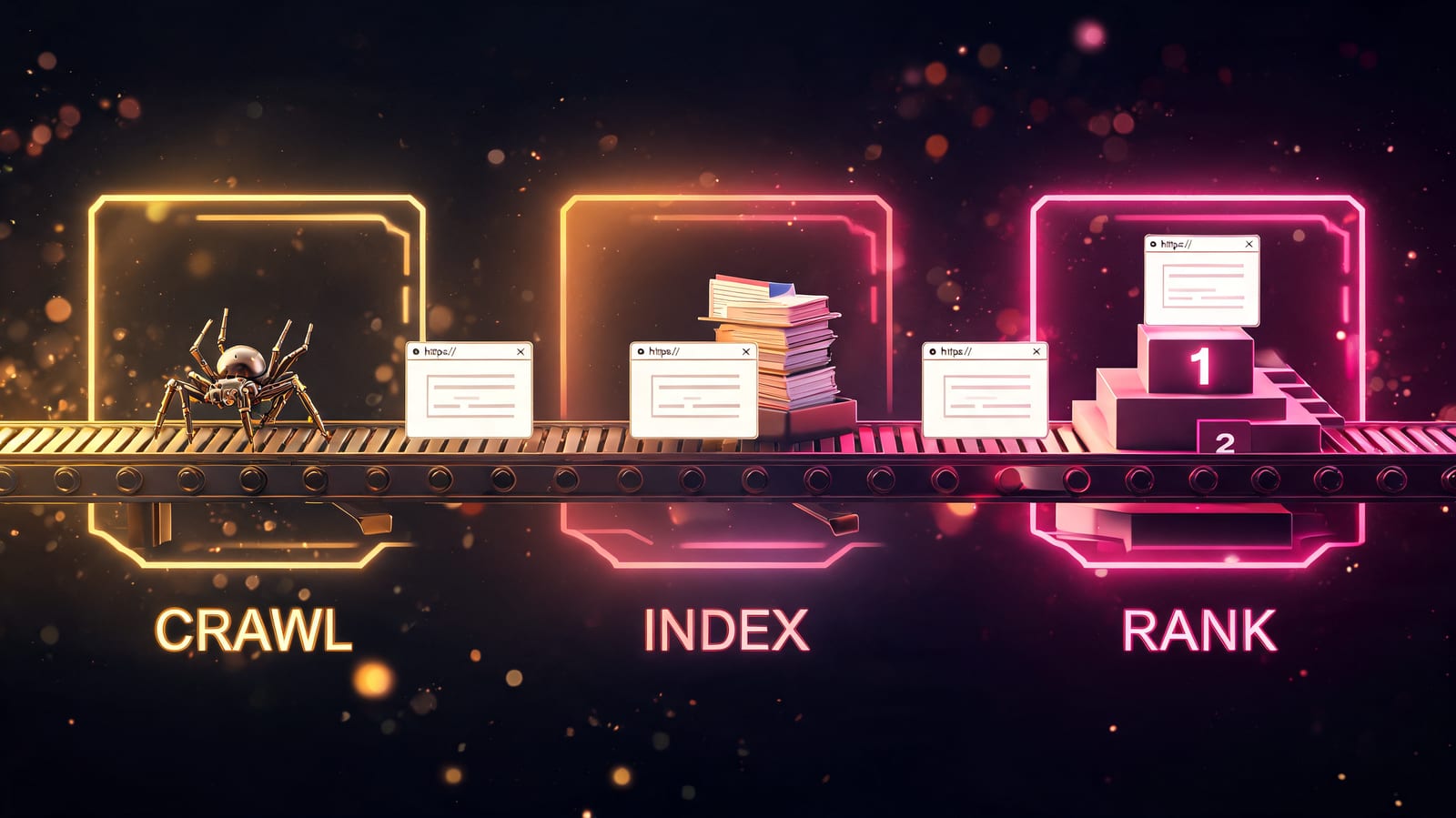
The three stages of SEO are crawling, indexing and ranking, the pipeline every page must pass through before it can show up in Google. First a search engine crawls your page (finds and reads it), then indexes it (stores and understands it), and finally ranks it (decides where it appears). Most problems are a failure at one of these stages.
That framing comes from Google itself. Its guide to how Google Search works says "Google Search works in three stages, and not all pages make it through each stage": crawling, indexing and serving search results. Google calls the last stage "serving"; SEOs usually call it ranking.
A quick note: "three stages" here means the search engine's process, how Google turns your page into a search result. That's different from the 4 stages of SEO, which describe your workflow (foundation, content, on-page, off-page). This page is about the machine's pipeline, not your to-do list. Both are useful; they just answer different questions.
Stage 1: Crawling. Can Google find and read the page?
Crawling is the discovery step. Search engines run automated bots (Google's is called Googlebot) that follow links from page to page across the web, reading the HTML as they go. Before anything else can happen, the crawler has to reach your page.
A page fails at the crawl stage when the bot can't get to it or can't read it:
- No links point to it. Crawlers travel along links. An orphan page with nothing linking to it, internally or from other sites, may never be discovered.
- robots.txt blocks it. A misconfigured robots.txt file can accidentally tell crawlers to stay away.
- It's buried too deep. Pages many clicks from the homepage get crawled less often, or not at all on smaller sites.
- The server is slow or erroring. If your site is down or painfully slow when the bot visits, the crawl fails.
How to help this stage: submit an XML sitemap through Google Search Console, keep a clean internal linking structure so every page is reachable, and make sure robots.txt isn't blocking anything important. Google's sitemap documentation limits a single sitemap to 50,000 URLs or 50MB uncompressed (so a site with more than 50,000 pages needs several sitemap files), and notes that submitting one "is merely a hint", so links still matter. Internal links do double duty here: they're how crawlers find pages and how link authority flows through your site.
Stage 2: Indexing. Does Google store and understand it?
Crawling a page doesn't guarantee it gets indexed. Indexing is where the search engine processes what it crawled: it renders the page, analyzes the content, works out what the page is about, and stores it in its database. Only indexed pages are eligible to rank. If a page isn't in the index, it cannot appear in search, no matter how good it is. Google's own guide is blunt about it: "Indexing isn't guaranteed; not every page that Google processes will be indexed."
Pages that get crawled but not indexed usually trip one of these:
- A
noindextag. An accidental noindex meta tag tells Google explicitly not to index the page. It's a very common cause of "why isn't my page showing up?" - Thin or duplicate content. Google may crawl a page, decide it adds nothing new, and choose not to index it. This is a major reason low-value pages vanish.
- Canonical confusion. If Google thinks another page is the "canonical" version, it may index that one instead of yours.
Check indexing directly with the URL Inspection tool in Google Search Console. It tells you whether a specific page is indexed and, if not, why. The fix is usually to remove an accidental noindex, or to make thin pages worth indexing by answering a real query well.
Stage 3: Ranking. Where does it place for a search?
Ranking is the stage everyone focuses on, but it only matters once the first two are cleared. When someone searches, Google pulls the relevant indexed pages and orders them using its ranking systems. This is where the competition happens: dozens or hundreds of indexed pages competing for the top spots on one query.
Ranking is driven by many signals, but the big ones are:
- Relevance and intent match. Does the page answer the query, in the format the searcher wanted? Matching search intent is often the deciding factor.
- Content quality and depth. Does it cover the topic well, better than the alternatives?
- Authority, mainly backlinks. Among pages that are equally relevant and well written, the one with the stronger backlink profile usually wins. Links are one way Google judges which pages the wider web trusts.
- Technical health. Page speed, mobile-friendliness and stability all feed in.
This is why two pages that answer a query equally well can rank pages apart: the difference is often authority. Good content that's crawled and indexed but has no links behind it can stall on page two. It cleared stages one and two but loses at stage three.
How do you use the three stages to diagnose problems?
Walk the page backward through the stages, starting with whether it is indexed at all. When a page isn't getting traffic:
- Is it ranking poorly, or not at all? Search for a unique sentence from the page in quotes. If it appears, it's indexed, and your issue is stage 3 (ranking), usually authority or intent.
- If it doesn't appear at all, check the URL Inspection tool. Not indexed? That's stage 2: look for a noindex tag or thin content.
- If Google says it can't even crawl it, that's stage 1: check robots.txt, internal links and your sitemap.
Diagnosing in this order saves a lot of time. Most people jump straight to "I need better rankings" (stage 3) when their real problem is a page that was never indexed (stage 2), and no amount of link building fixes that. Google also says it "doesn't guarantee that it will crawl, index, or serve your page" even when a site follows its rules, so a single missing page is not always a sign that something is broken.
Where Backlinkster fits
The first two stages are things you control on your own site. Stage three, ranking, is where you compete with everyone else, and it depends heavily on authority you have to earn. That's the hardest part to do alone, especially for a newer site. Backlinkster helps with the ranking stage by matching you with site owners in relevant niches to trade in-content backlinks 1-for-1, and each swap is verified by API. The free tier is five swaps a month.
Frequently asked questions
What are the three stages of SEO in order?
Crawling, indexing and ranking. Google first discovers and reads a page, then stores and understands it, then decides where to show it for each search. A page has to clear each stage before the next one matters.
What is the difference between crawling and indexing?
Crawling is Google fetching and reading a page. Indexing is Google processing that page and storing it so it can appear in results. A page can be crawled and still not be indexed, for example if it has a noindex tag or adds nothing new.
How do I know which stage my page is stuck at?
Use the URL Inspection tool in Google Search Console. It shows whether Google could crawl the page, whether it is indexed and why not. If it is indexed but gets no traffic, the problem is ranking.
Does submitting a sitemap guarantee indexing?
No. Google calls a sitemap "merely a hint". It helps Google find URLs, especially on new or large sites, but each page still has to earn its place in the index.
The takeaway
The three stages of SEO, crawl, index and rank, are the pipeline every page runs to reach a searcher. A page has to be found, then stored and understood, then placed against competitors. Each stage has its own failure modes and its own fixes, and most traffic problems come down to one specific stage breaking. Learn to spot which stage is failing, and you'll stop guessing and start fixing the actual bottleneck.
Related: The 4 stages of SEO · The three main areas of SEO · The 4 intents of SEO · How to get your website indexed by Google